



June 18, 2026
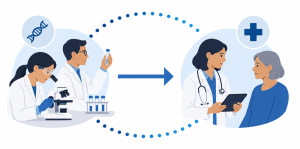
In communication sciences and across biomedical research, there is a significant gap between the number of discoveries being made and how many of those discoveries are actually applied to clinical care. This gap between what we know and what we do reflects system-level and behavioral barriers that have profound impacts on patient health. It can take an average of 17 years for new science to reach routine clinical use, and many patients commonly receive only half of the recommended care. Bridging this “know-do” gap requires coordinated effort and engagement across providers, systems, and researchers to not only disseminate scientific discovery but to implement it as well.
In this director’s message, I outline NIDCD’s strategic activities to increase the quality and quantity of dissemination and implementation (D&I) research in communication disorders to narrow the gap between research and clinical practice. I also summarize topics from the May meeting of the National Deafness and Other Communication Disorders Advisory Council.
D&I as a Strategic Focus for NIDCD
Research requires active approaches and strategies for both spreading evidence to a target audience (dissemination) and integrating evidence into practice (implementation) for it to truly influence health and well-being. In recognition of how integral D&I research is to NIDCD’s mission, D&I research is a focus of the institute’s 2023–2027 Strategic Plan, in Theme 4, Goal 2: Develop, disseminate, and implement evidence-based practices that improve health-related outcomes. I outlined NIDCD’s dedication to D&I science in a 2023 publication in the American Academy of Otolaryngology-Head and Neck Surgery.
NIDCD has several major strategies to grow community engagement in D&I research:
- Convening experts through workshops, seminars, and other events
- Supporting innovative projects through targeted funding
- Training and mentoring the next generation of D&I investigators
In line with these strategies, NIDCD has hosted and supported several D&I-focused events:
- To build collective capacity and define the future landscape to sustain D&I research, NIDCD hosted a two-day workshop on D&I science. The event brought together more than 150 participants to identify needs and opportunities for investigators across NIDCD mission areas. Key themes from the workshop were the need for stronger mentorship, the value of earlier exposure to D&I research methods, and the importance of cross-sector partnerships.
- To demonstrate how D&I science can directly accelerate the impact of NIDCD's mission, we featured Meghan Lane-Fall, M.D., M.S.H.P., a nationally recognized leader in implementation science in the 2024 NIDCD Director’s Seminar Series. Her presentation, “Making Sense of Dissemination and Implementation Research: Opportunities for NIDCD to Accelerate Impact”, described core D&I principles and shared how D&I science strengthens NIDCD mission areas.
- To actively build the D&I researcher pipeline and boost the number of D&I grant proposals, NIDCD provides grant funding to expand the American Speech-Language-Hearing Association (ASHA) Dissemination and Implementation Science Travel Award and Conference Event (DISTAnCE). As part of its Academic & Research Mentoring (ARM) Network, the event increases the D&I knowledge base for researchers across all career stages who are interested in or working toward conducting high quality D&I research in NIDCD mission areas.
NIDCD is also offering D&I funding opportunities:
- NIDCD is driving early-stage D&I research projects across all NIDCD’s mission areas through our R21 program, “Early-Stage Dissemination and Implementation Research in Communication Disorders”. There are four newly awarded projects on caregiver coaching in early intervention, vestibular rehabilitation therapy trials in emergency departments, support groups for families of children with developmental language disorder (DLD), and reading instruction for students using augmentative and alternative communication (AAC) devices. Applications for 2028 awards may be submitted before June 17, 2027, through (RFA-DC-26-001).
- To cultivate the next generation of D&I researchers and help investigators build foundational skills, NIDCD is leading the NIH Highlighted Topic “Training and Career Development in Dissemination and Implementation Science.” This exciting opportunity offers funding through fellowships (F), career development awards (K), training grants (T series), and education projects (R25). I encourage early-career investigators interested in building foundational D&I skills to apply. This highlighted topic is currently active until April 14, 2028.
Other Updates from the Director
I would also like to highlight the recent NIDCD Director’s Seminar Series event, “Wearables and Machine Learning Changing Health Access and Science”, held on May 13. The hybrid lecture featured a presentation by Guillermo Sapiro, Ph.D., and panelists Blake Wilson, Ph.D., D.Sc., D.Eng., and Rupal Patel, Ph.D., M.H.Sc. Dr. Sapiro discussed how everyday technologies such as smartphones, smartwatches, and earbuds are transforming healthcare, and how artificial intelligence (AI) and machine learning (ML) can provide new health insights and help identify biological markers linked to communication disorders.
Additionally, the Advanced Research Projects Agency for Health (ARPA-H) hosted its Hearing Enhancement through ARtificially Intelligent NeurotechnoloGy (HEARING) Proposers’ Day on June 8. The HEARING Program will fund innovative proposals with the goal of developing the first-ever minimally invasive hearing system that works directly with the auditory cortex. Interested parties can review the solicitation at ARPA-H-SOL-26-154. Solution summaries are due June 29, 2026.
I am excited for the many enriching activities and opportunities NIDCD offers, especially in D&I science. I hope that these opportunities galvanize engagement in D&I so that scientific advancement across NIDCD mission areas can be transformed into meaningful clinical care.
National Deafness and Other Communication Disorders (NDCD) Advisory Council Meeting, May 14, 2026
On May 14, the institute’s Advisory Council convened in person. Portions of our Council meetings are open to the public. I invite you to watch the archived VideoCast of the open session and to join us online for our next meeting, to be held September 3 and 4. A few highlights from May’s meeting are summarized below.
- Adam Politis, Ph.D., M.S., and Theresa Cruz, Ph.D., provided information on the NIH Strategic Plan for Disability Health Research. The plan will advance innovative and responsible research to improve the health and well-being of people with disabilities. The plan was released recently, in March of this year, and will complement NIDCD’s own strategic plan by providing a framework for research that considers the unique needs of people with disabilities and their communities. To view this segment, start at the 00:26:07 mark of the VideoCast.
- NIH Director Jay Bhattacharya, M.D., Ph.D., shared his vision for advancing science at NIH through three main strategies: (1) increasing funding for cutting-edge science through the NIH Unified Funding Strategy, (2) addressing the replication crisis by establishing platforms and processes that promote replication studies, and (3) developing strategies to award funds equitably across institutions. To view this segment, start at the 01:00:59 mark of the VideoCast.
- Swathi Kiran, Ph.D., CCC-SLP, shared an update from the NDCD Advisory Council Clinical Trials Working Group. The working group has been conducting interviews with the internal and external scientific community to determine how NIDCD can improve and support its pipeline of clinical trials. The group will deliver a final report and recommendations to the Advisory Council at the September meeting. To view this segment, start at the 02:03:15 mark of the VideoCast.
- Trinh Ly, M.D., presented a concept for clearance, “Phased Cooperative Agreement for Clinical Trials.” The concept aims to replace the current cooperative agreement funding opportunity for clinical trials at NIDCD with a two-phase funding structure that includes a planning phase followed by a clinical trial implementation phase. Jaclyn Schurman, Au.D., Ph.D., also presented a concept, “NIDCD Research Fellowship for Audiologists.” The concept aims to renew a program to support clinical audiologists enrolled in doctoral programs. Concepts describe the basic purpose, scope, and objectives of proposed initiatives and represent an early planning stage for potential funding opportunities. NIDCD uses the concept clearance process to gather input from the NDCD Advisory Council about the merits of the concepts and to enhance transparency by making the NIDCD research community aware of potential initiatives that may be developed into published funding opportunities. Council approval of a concept does not guarantee that it will become a funding opportunity. To view this segment, start at the 02:13:45 mark of the VideoCast.
- Judith Cooper, Ph.D., NIDCD Division of Scientific Programs (DSP) Director, and Becky Wagenaar-Miller, Ph.D., NIDCD Division of Extramural Activities (DEA) Director, shared staffing updates to NIDCD. To view this segment, start at the 02:27:58 mark of the VideoCast.
- Alberto Rivera-Rentas, Ph.D., retired from his position as an NIDCD Research Training Officer.
- Susan Sullivan, Ph.D., retired from her position as an NIDCD Program Officer in Taste and Smell.
- Melissa Stick, Ph.D., has moved to the Training Group Chief in DEA.
- Dr. Schurman has moved to the NIDCD DEA Training Group.