Home
Research
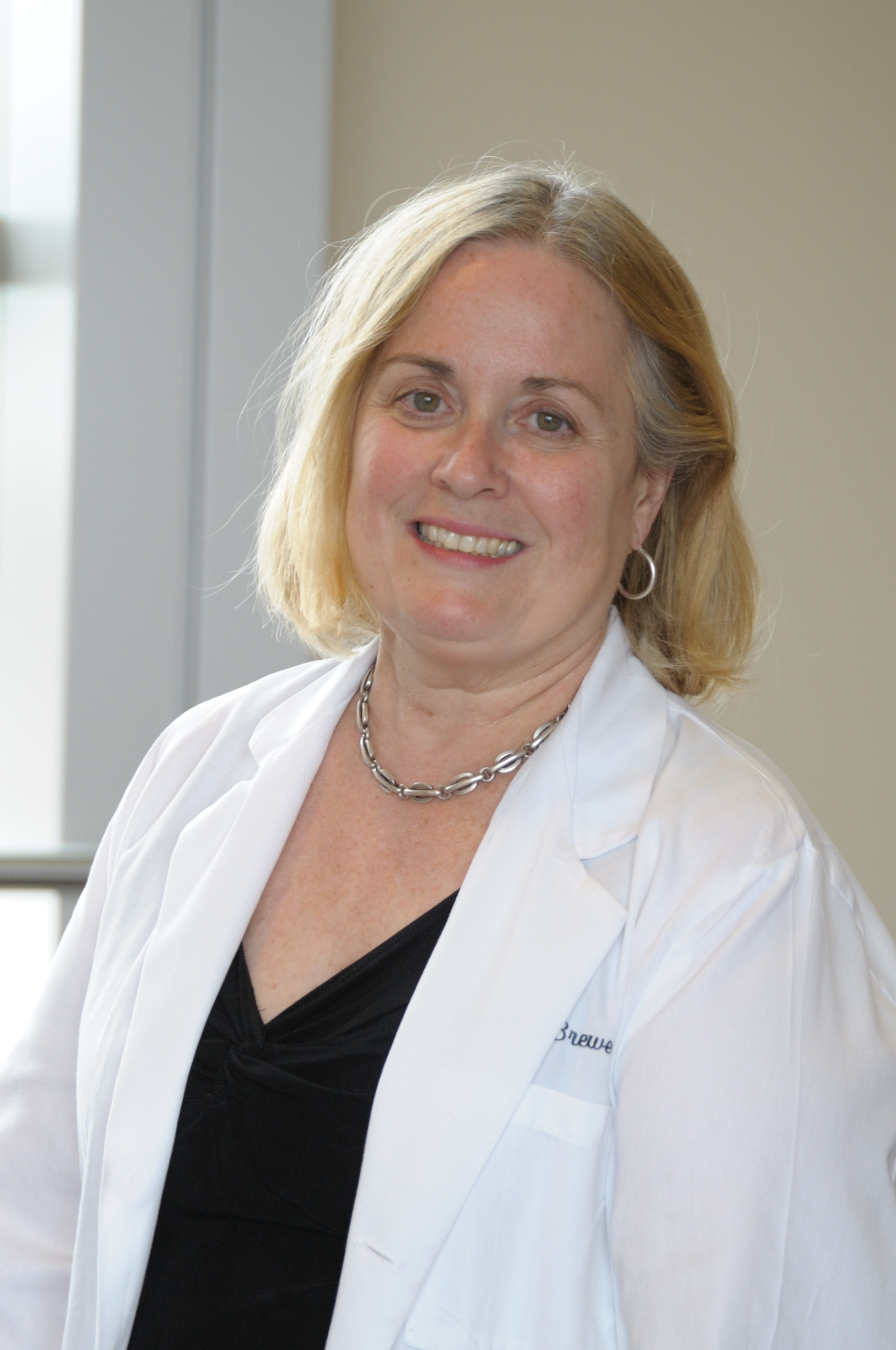
Carmen C. Brewer, Ph.D.
Chief Research Audiologist
Audiology Unit
NIDCD/NIH
Building 10, Room 5C306
9000 Rockville Pike
Bethesda, MD 20892
Phone: (301) 496-5294
Fax: (301) 402-0409
E-mail: brewerc@nidcd.nih.gov
Carmen Brewer, Ph.D., received a B.A. from Rutgers University and an M.A. and Ph.D. in Audiology and Hearing Science from the University of Maryland. Dr. Brewer began her career as a clinical fellow in Audiology at the Washington Hospital Center, and eventually became Director of the Hearing and Speech Center. During her tenure at Washington Hospital Center, she gained considerable experience in the audiologic assessment and rehabilitation of adult patients of all ages, developed and implemented a newborn hearing screening program, developed community outreach programs, and administered a comprehensive audiology and speech pathology program. In 2002, Dr. Brewer moved to the NIDCD, where she is the Chief of the Audiology Unit.
Dr Brewer’s research interests include ototoxicity, genotype/phenotype relationships in hereditary hearing loss, heritability of auditory processing skills, and balance function in Usher syndrome.
On this page:
Research Audiologists
Christopher Zalewski , M.A., Research Audiologist
301-496-5145 (Send e-mail)
Chris Zalewski earned a B.A. from Pennsylvania State University, an M.A. in Audiology from the University of Maryland, and is working towards a Ph.D. in Audiology at Gallaudet University. He joined the NIDCD as a staff audiologist in 2002. His principal interests are vestibular disorders and the genetics of hearing loss.
Kelly A. King, Au.D., Ph.D., Research Audiologist
301-496-5036 (Send e-mail)
Dr. King received her Au.D. and Ph.D. degrees from the University of Maryland College Park. She has worked with the intramural Audiology Unit at NIDCD since 2004. Her primary research interests include the auditory phenotype of Neimann Pick C and other neurologic diseases affecting the auditory system.
Top
Mission

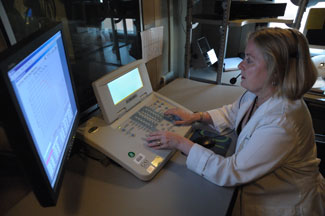
Chris Zalewski assesses balance function using computerized platform posturography.
The Audiology Unit functions as both a research and clinical laboratory. Within these broad areas, we develop and conduct audiology-specific research studies, collaborate with intramural investigators in the development and implementation of protocols that include assessment of the auditory and vestibular systems, provide audiology services to support the NIH Clinical Center and patient needs, and provide clinical and research training and mentoring.
Research Statement
Currently, our research can be divided into three areas: 1) natural history of disorders affecting the auditory and vestibular systems, 2) clinical monitoring of potentially ototoxic therapeutic and diagnostic interventions, and 3) investigation of auditory processing skills.
Our natural history studies are directed toward identifying and defining distinctive auditory and vestibular phenotypes , understanding their pathogenesis, and correlating these phenotypes with underlying molecular genotypes. Many of our studies are multidisciplinary and part of NICHD, NEI, NCI, NIAMS, NINDS, and NHGRI clinical research protocols on a variety of chromosomal and syndromic disorders affecting hearing and balance. We use a comprehensive battery of auditory and vestibular measures that includes otoacoustic emissions, wideband acoustic reflectance, assessment of auditory processing, auditory and vestibular evoked potentials, videonystagmography, rotary vestibular testing, and computerized dynamic platform posturography. Examples of ongoing research include examining auditory and/or vestibular manifestations of neurofibromatosis type 2 (NF2), Usher syndrome, enlarged vestibular aqueduct (EVA), Neimann Pick type C (NPC), xeroderma pigmentosum (XP) and neonatal onset multisystem inflammatory disorder (NOMID).
Vestibular function is assessed using rotary vestibular testing (left) and videonystagmography (right).
Our clinical monitoring studies focus on hearing loss associated with ototoxins and clinical noise (e.g., MRI, TMS). They are conducted with the aim of early identification of hearing loss as well as long term monitoring of patients treated with potentially ototoxic drugs such as aminoglycoside antibiotics, cisplatinum, experimental therapies, and as the result of radiation therapy to the brain.

Audiology students prepare to test auditory processing skills of twins.
We conduct studies of auditory processing (AP) that focus on heritability of these skills in the general population and manifestation of these abilities in certain patient groups. In conjunction with the NIDCD’s the Laboratory of Molecular Genetics, we have shown that dichotic listening, or the ability to listen to and understand different speech signals presented to each ear at the same time, is inherited (Morell, et al. 2007). We are currently expanding this research to determine if there is heritability for AP of non-speech signals as well. This will enable us to understand better the underpinnings of AP. To date, much of this work has been conducted at the Annual Twins Days Festival in Twinsburg, Ohio, where our team of researchers evaluates AP skills of volunteer twin pairs. We are also examining AP skills in groups of patients with syndromes that may affect AP such as OCA, NF1 and WAGR syndrome.
Student Mentorship Programs
The Audiology Unit offers clinical and research mentorship opportunities. A placement at the NIH is best suited for a person who is interested in the medical and/or genetic aspects of audiology, as well as those who may have an interest in eventually pursuing a Ph.D. or a career in research. Information regarding application for these programs is located here.

Dr. Brewer provides instruction to a student as a patient is prepared for auditory evoked potential testing.
Clinical Opportunities
Clinical mentorship opportunities are available to Doctor of Audiology (Au.D) or Ph.D. students only. These are offered year round on a semester or quarterly basis, in conjunction with the student’s academic program. We see adult and pediatric patients with a wide range of rare diseases and syndromes, patients on potentially ototoxic and/or investigational treatments, as well as healthy volunteers. Students are given the opportunity to work closely with the NIDCD otolaryngologists, other physicians, and various other medical professionals. In addition, students may participate in weekly lab meetings and periodic journal clubs, attend NIDCD seminar lecture series, and on occasion attend NIH-sponsored lectures from world-renowned scientists and physicians.
Research Opportunities
Semester, summer, and project-based research opportunities are available to high school, undergraduate, and graduate students.
Summer research program: This opportunity is available to high school, undergraduate, and graduate students and is subject to availability from year-to-year depending on research needs. Projects include retrospective review and data analysis, and preparation for data acquisition for upcoming projects. Those interested in participating in the NIH summer student research program must apply though https://www.training.nih.gov/programs/sip. We give preference to those pursuing a career in audiology or hearing science. Summer students participate in lab meetings and journal club. Those completing a project with data analysis are expected to present at least one status report in our lab meetings and to prepare a poster for presentation at the NIH Summer Research Festival.
Semester and project based research: This opportunity is available to doctoral students in audiology/hearing science who are seeking to complete a research project as part of their academic requirements for the doctoral degree. We primarily offer opportunities for retrospective review and data analysis, and mentor the student through literature review, design of experimental questions, database management, statistical analysis, and research product development. The research product may be a capstone project, thesis, dissertation, research poster, and/or a manuscript submitted for publication. Independent work is expected. Approval by your academic advisor is required before we will agree to a research rotation. You will be required to lead at least one journal club, and make at least one presentation during lab meeting.
Selected Student Projects
- Rachel Baron, undergraduate neuroscience major, University of Virginia, Charlottesville, VA Baron R, Zalewski C, King KA, Muskett J, Butman J, Griffith A, Brewer C. (2011). Vestibular phenotype of enlarged vestibular aqueduct. Poster presented at the NIH Summer Poster Series, Bethesda, MD, August 2011.
- Andrew Golboro, undergraduate hearing and speech sciences major, University of Maryland, College Park, MD Golboro A, King KA, Zalewski C, Adams D, Brewer C. Auditory phenotype of Oculocutaneous Albinism (OCA). Poster presented at the NIH Summer Poster Series, Bethesda, MD, August 2010.
- Neda Ahmadi, M.D., otolaryngology resident, Georgetown University, Washington DC Ahmadi N, Brewer C, Zalewski C, King K, Butman J, Plass N, Henderson C, Goldbach-Mansky R, Kim, J. Cryopyrin-Associated Periodic Syndromes (CAPS): Otolaryngologic and Audiologic Manifestations. Oral Presentation at the Annual Meeting of American Academy of Otolaryngology-HNS, Boston, MA, September 2010.
- Ahmadi N, Brewer C, Zalewski C, King K, Butman J, Plass N, Henderson C, Goldbach-Mansky R, Kim J. Cryopyrin-Associated Periodic Syndromes (CAPS): Otolaryngologic and Audiologic Manifestation, Otolaryngology-Head and Neck Surgery, epub March 31, 2011.
- Alyssa Baker, Au.D. student, University of Maryland, College Park, MD Baker A, Zalewski C, King K, Kim HJ, Fitzgerald T, Kelly M, Collins M, Brewer C. Auditory Phenotype of McCune Albright Syndrome. Oral presentation and award, Student Research Forum, American Academy of Audiology meeting, Chicago, April 2011.
- Laize Barcelos Corse, Au.D. student, Towson University, Towson, MD
Barcelos Corse L, King K, Zalewski C, Baldwin A, Masciocchi M, Gillespie A, Weidemann B, Brewer C. Audiologic phenotype in individuals with Neurofibromatosis type I. Poster session presented at the American Academy of Audiology meeting, San Diego, April 2010.
- Jennifer Bentley, Au.D. student, Rush University, Chicago, IL
Bentley J, Brewer C, Morse R, Zalewski C, Smith ACM. Hyperacusis in patients with Smith Magenis syndrome. Poster presented at American Academy of Audiology, Denver, April 2007.
Top
Selected Publications
2011
- Rehman A, Gul K, Morell R, Lee K, Ahmed Z, Riazuddin S, Ali R, Shahzad M, Jaleel, A, Andrade P, Khan SN, Khan S, Brewer C, Ahmad W, Leal S, Riazuddin S, Friedman TB. Mutations of GIPC3 cause nonsyndromic deafness DFNB72but not DFNB81 that also maps to chromosome 19p, Human Genetics, e pub June 2011.
- Ahmadi N, Brewer C, Zalewski C, King K, Butman J, Plass N., Henderson C, Goldbach-Mansky R, Kim J. Cryopyrin-Associated Periodic Syndromes (CAPS): Otolaryngologic and Audiologic Manifestations, Otolaryngology-Head and Neck Surgery, epub March 31, 2011.
- Guardiani E, Zalewski C, Brewer C, Merideth M, Introne W, SmithACM, Gordon L, Gahl W, Kim HJ. Otologic and Audiologic Manifestations of Hutchinson-Gilford Progeria Syndrome, Laryngoscope, epub Sept 6, 2011.
- Schultz JM, Bhatti R, Madeo A, Turriff A, Muskett A, Zalewski C, King K, Ahmed Z, Riazuddin S, Ahmad N, Hussain Z, Qasim M, Khan S, Meltzer M, Liu X, Munisamy M, Ghosh M, Rehm H, Tsilou E, Griffith A, Zein W, Brewer C, Riazuddin S, Friedman,TB. Allelic hierarchy of CDH23 mutations causing nonsyndromic deafness DFNB12 or Usher Syndrome USH1D, Human Genetics, epub Sept 22, 2011.
2010
- Yanjanin N, Velez J, Gropman A, King K, Bianconi S, Conley S, Brewer C, Solomon B, Pavan W, Arcos-Burgos M, Patterson M, and Porter FD. Linear progression, independent of age of onset, in Niemann Pick disease, type C. Am Journal of Medical Genetics Part B: Neuropsychiatric Genetics, 153B (1): 132-40, 2010.
- King K, Choi BY, Zalewski C, Madeo AC, Manichaikul A, Pryor SP, Ferruggiaro A, Eisenman D, Kim HN, Niparko J, Thomsen J, Butman JA, Griffith AJ, Brewer CC. SLC26A4 genotype, but not cochlear radiologic structure, is correlated with hearing loss in ears with an enlarged vestibular aqueduct. Laryngoscope, 120(2), 384-9, 2010.
2009
- Khan SG, Oh KS, Emmert S, Imoto K, Tamura D, Digiovanna JJ, Shahlavi T, Armstrong N, Baker CC, Neuburg M, Zalewski C, Brewer C, Wiggs E, Schiffmann R, Kraemer KH. XPC initiation codon mutation in xeroderma pigmentosum patients with and without neurological symptoms. DNA Repair (Amst). 8(1): 114-25, 2009.
- Jones JL, Zalewski C, Brewer C, Lucker J, Drayna D. Widespread auditory deficits in tune deafness. Ear Hear. Feb; 30(1):63-72, 2009.
- Choi BY, Stewart A, Madeo A, Pryor S, Lenhard S, Kittles R, Eisenman D, Kim HJ, Niparko J, Thomsen J, Arnos K, Nance W, King K, Zalewski C, Brewer, C., Shawker T, Reynolds J, Butman J, Karniski J, Alper S, Griffith A. Hypo-functional SLC26A4 variants associated with nonsyndromic hearing loss and enlargement of the vestibular aqueduct: genotype-phenotype correlation or coincidental polymorphisms? Hum. Mutat., 2009.
- Jones, JL, Lucker, J, Zalewski C, Brewer, C, and Drayna, D. Phonological Processing In Adults with Deficits in Musical Pitch Recognition. Journal of Communciation Disorders, 42, 2009.
- Johnson L, Morgan R, Dudley M, Cassard L, Yang JC, Hughes MS, Kammula US, Royal RE, Sherry RM, Wunderlich JR, Lee CC, Restifo NP, Schwarz SL, Cogdill AP, Bishop RJ, Kim H, Brewer CC, Rudy SF, Vanwaes C, Davis JL, Mathur A, Ripley RT, Nathan DA, Laurencot CM, Rosenberg SA. Gene therapy with human and mouse t-cell receptors mediates cancer regression and targets normal tissues expressing cognate antigen. Blood, 114(3) 535-546, 2009.
- Makishima T, King K, Brewer CC, Zalewski CK, Butman J, Bakalov VK, Bondy C, Griffith AJ. Otolaryngologic markers for the early diagnosis of Turner syndrome. Int J Pediatr Otorhinolaryngol, 73(11) 1564-7, 2009.
- Rossi S, Hallett M, Rossini PM, Pascual-Leone A and the Safety of TMS Consensus Group [Brewer, CC, et al.]. Safety, Ethical Considerations, and Application Guidelines for the Use of Transcranial Magnetic Stimulation in Clinical Practice and Research. Clin Neurophysiol, 120(12), 2008-39, 2009.
- Choi BY, Madeo AC, King KA, Zalewski CK, Pryor SP, Muskett JA, Nance WE, Butman JA, Brewer CC, Griffith AJ. Segregation of enlarged vestibular aqueducts in families with non-diagnostic SLC26A4 genotypes. J Med Genet. 46(12):856-61, 2009.
2008
- Merideth M, Gordon L, Claus S, Sachdey V, Smith A, Perry M, Brewer C, Zalewski C, Kim HJ, Solomon B, Brooks B, Gerber L, Turner M, Domingo D, Hart T, Graf J, Reynolds J, Gropman A, Yanovski J, Collins F, Nabel E, Cannon R, Gahl W, Introne W. Hutchinson-Gilford Progeria syndrome: phenotype and course. New England Journal of Medicine, 358(6): 592-604, 2008.
- Braun A, McArdle J, Nechaev V, Zalewski,C, Brewer C, Drayna, D. Tune deafness: processing melodic errors outside of conscious awareness as reflected by components of the auditory ERP. PLoS ONE, 3(6): e2394, June 11, 2008.
2007
- Reis M, Kim J, Zalewski C, Mastrioianni M, Moore D, Brady R, Schiffman R, Brewer C. Neuropathic and cerebrovascular correlates of hearing loss in Fabry disease. Brain, 130:143-150, 2007.
- Makishima T, Madeo AC, Brewer CC, Zalewski CK, Butman JA, Sachdev V, Arai AE, Holbrook BM, Rosing DR, Griffith AJ. Nonsyndromic hearing loss DFNA10 and a novel mutation of EYA4: evidence for correlation of normal cardiac phenotype with truncating mutations of the Eya domain. American Journal of Medical Genetics, 143(14): 1592-8, 2007.
- Morell R, Brewer C, Dongliang G, Snieder H, Zalewski C, King K, Drayna D, Friedman T. A twin study of auditory processing indicates that dichotic listening ability is a strongly heritable trait. Human Genetics, 122 (1), 103-111, 2007.
- Jagannathan J, Butman JA, Lonser RR, Vortmeyer AA, Zalewski C, Brewer C, Oldfield EH, Kim HJ. Endolymphatic sac tumor demonstrated by intralabyrinthine hemorrhage. Case report. Journal of Neurosurgery, 107(2): 421-425, 2007.
- Jagannathan J, Lonser RR, Stanger RA, Butman JA, Vortmeyer AA, Zalewski C, Brewer C, Surowicz CM, Kim HJ. Cochlear implantation for hearing loss associated with bilateral endolynphatic sac tumors in von Hippel-Lindau disease. Otology and Neurotology, 28(7): 927-930, 2007.
- King K, Makishima T, Zalewski C, Bakalov, V, Griffith A, Bondy C, Brewer C. Analysis of Auditory Phenotype and Karyotype in 200 Females with Turner syndrome. Ear and Hearing, 28:831-841, 2007.
- Doherty ES, Lachbawan F, Hadley DW, Brewer C, Zalewski C, Kim HJ, Solomon B, Robenbaum K, Domingo D, Hart TC, Brooks B, Immken L, Lowry RB, Kimonis V, Shanske AL, Jehee FS, Bueno MRP, Knightley C, McDonald-McGinn D, Zacai E, Muenke M. Muenke syndrome (FGFR3) related craniosynostosis): expansion of the phenotype and review of the literature. American Journal of Medical Genetics, Part A 143A: 3204-3215, 2007.
Top